Home › Blog ›
How to Choose a Strong PGP Passphrase
Cryptography
🔑 How to Choose a Strong PGP Passphrase
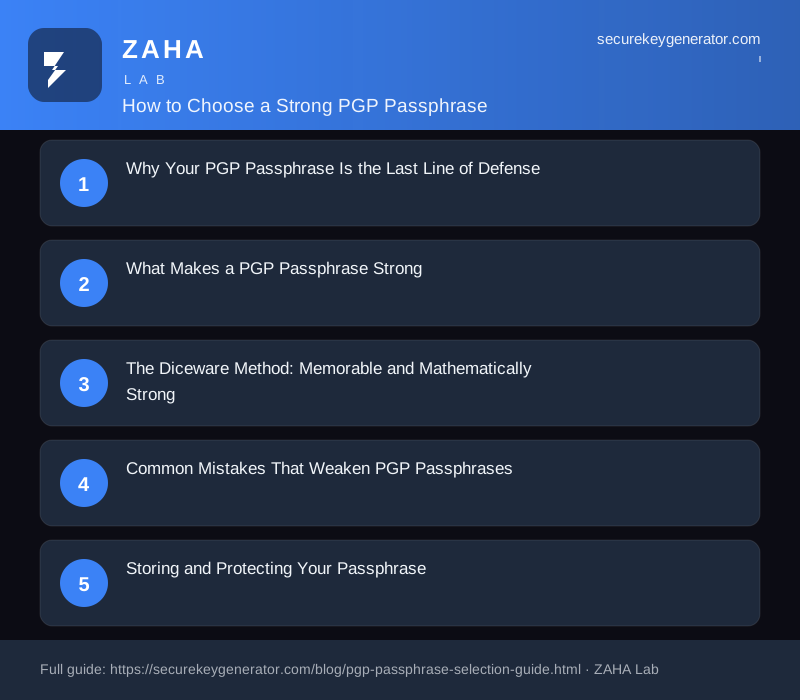
How to Choose a Strong PGP Passphrase, key points at a glance
By Dr. Sarah Chen, · 9 Apr 2026 · 3 min read · 0 words
Your PGP private key is only as secure as the passphrase that protects it. If an attacker gains access to your private key file, a weak passphrase can be cracked offline using dictionary or brute force attacks, giving them full access to your encrypted communications and digital signatures. A strong PGP passphrase should have at least 80 bits of entropy, ideally 128 bits or more.
Generating a high-entropy passphrase that is still memorable enough to type correctly every time requires careful design. NordPass includes a passphrase generator that creates random word sequences with configurable word counts and separators, producing passphrases that are both secure and usable. Store your master PGP passphrase in your NordPass vault for backup access, safe from shoulder surfers and keyloggers.
Why Your PGP Passphrase Is the Last Line of Defense
Pretty Good Privacy (PGP) protects your messages and files with strong public-key cryptography, but that protection rests entirely on a single secret: the passphrase guarding your private key. Even the most robust encryption algorithm becomes worthless if an attacker who steals your private key file can guess the passphrase that opens up it. Unlike a typical website password, your PGP passphrase is never transmitted anywhere and never reset by an administrator. There is no "forgot password" link. If you lose it, your encrypted data is gone forever; if someone else learns it, your entire correspondence is exposed. That dual reality makes choosing a strong passphrase one of the most consequential security decisions you will make.
What Makes a PGP Passphrase Strong
Strength comes from entropy, the measure of how unpredictable your passphrase is. A short, common word has very little entropy and can be cracked in seconds by software that tries millions of combinations per second. A long, random sequence has so much entropy that brute-forcing it would take longer than the age of the universe. The goal is not to invent something clever you can remember through a trick, but to maximize genuine randomness while keeping the result memorable enough to type reliably.
When evaluating a passphrase, focus on these properties:
Length over complexity: A 25-character passphrase made of ordinary words beats a cryptic 10-character string of symbols. Length is the single biggest contributor to entropy.
True randomness: Human-chosen "random" text is predictable. Use a reliable random source rather than your imagination.
Uniqueness: Your PGP passphrase must never be reused from any other account or service.
No personal data: Names, birthdays, pet names, and addresses are the first things an attacker tries.
The Diceware Method: Memorable and Mathematically Strong
The most widely recommended approach for PGP passphrases is Diceware. You roll physical dice to select random words from a standardized list of thousands of short words. Each word adds roughly 12.9 bits of entropy, so a six-word Diceware passphrase delivers around 77 bits, comfortably beyond what current and foreseeable hardware can crack. A typical result might look like "anchor velvet ridge moth tunnel grape": easy to picture, easy to type, and effectively impossible to guess.
To use Diceware effectively:
Use at least six words for a private key you genuinely care about; seven or eight for high-value or long-lived keys.
Roll real dice or use a cryptographically secure generator, never pick words because they "feel" random.
Keep the spaces or separators between words; they are part of the passphrase and add a little extra length.
Do not substitute "memorable" words of your own choosing, which collapses the entropy the method provides.
Common Mistakes That Weaken PGP Passphrases
Many people undermine an otherwise good setup with predictable habits. Avoid these traps:
Quotes and song lyrics: Any phrase that appears in books, films, or online is in attacker wordlists.
Predictable substitutions: Swapping "a" for "@" or "e" for "3" adds almost no real security; cracking tools account for it automatically.
Keyboard patterns: Sequences like "qwerty" or "1q2w3e" are among the first guesses attempted.
Reusing an existing password: If that password leaks in any breach, your private key is immediately at risk.
Storing and Protecting Your Passphrase
A strong passphrase only helps if you can recall it and keep it secret. Because PGP passphrases are long, consider committing yours to memory through repeated practice in the first few days after creating it, and store a backup in a reputable password manager protected by its own strong master password. If you write it on paper, keep that paper somewhere physically secure, such as a safe, never on a sticky note near your computer. Never store the passphrase in the same location as the private key file itself, since an attacker who obtains one should not automatically obtain the other.
Putting It All Together
Choosing a strong PGP passphrase comes down to a few durable principles: generate it with genuine randomness, favor length through methods like Diceware, keep it unique to your key, and store it carefully. Your encryption is only as trustworthy as the secret that opens up it. Invest a few minutes in getting this right, and the cryptography behind PGP will do the rest, keeping your communications confidential for years to come.
We use cookies to improve your experience. Learn more
Why Passphrase Length Beats Complexity
Modern attackers use GPU rigs and rainbow tables that test billions of guesses per second, so a short password peppered with symbols offers far less protection than a long, memorable string of words. Length expands the search space exponentially, which is exactly what frustrates brute-force attempts against your PGP private key.
A passphrase of five or more random words typically delivers far more entropy than an eight-character password crammed with substitutions like "P@ssw0rd!". The longer phrase is also easier to recall, meaning you are less tempted to write it down somewhere risky.
Use the Diceware Method
Diceware is a proven technique for generating high-entropy passphrases using physical dice and a numbered word list. Roll five dice, read the resulting five-digit number, and look up the matching word. Repeat until you have six or seven words strung together.
Roll dice to select truly random words, removing predictable human bias.
Aim for at least six words to reach roughly 77 bits of entropy.
Keep the words in their generated order rather than rearranging them.
Add a random separator or capital letter only if you can still remember it.
Common Mistakes to Avoid
Even careful users undermine their own security with predictable choices. Steer clear of these traps when crafting your passphrase:
Song lyrics, movie quotes, or famous sayings that appear in cracking dictionaries.
Personal details such as birthdays, pet names, or street addresses.
Reusing a passphrase that already protects another account or key.
Simple keyboard patterns like "qwerty" or sequential numbers.
Finally, store your passphrase only in a reputable password manager or your own memory, and never transmit it over email or chat. A strong passphrase protects your private key even if the encrypted keyfile itself is stolen.