Home › Blog ›
PassGAN and AI: How Neural Networks Crack Passwords in 2026
Cryptography
🤖 PassGAN and AI: How Neural Networks Crack Passwords in 2026
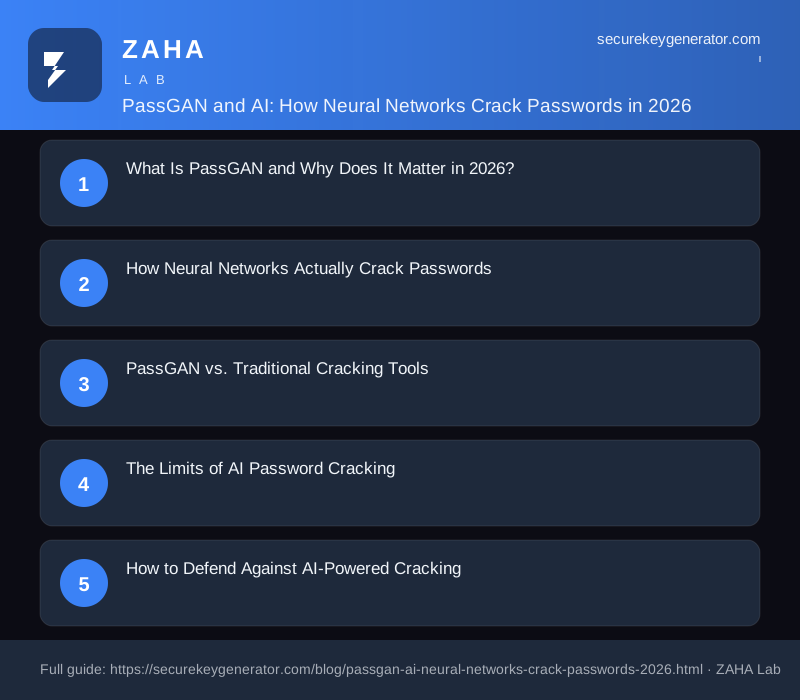
PassGAN and AI: How Neural Networks Crack Passwords in 2026, key points at a glance
By Dr. Sarah Chen, · 1 June 2026 · 3 min read · 0 words
PassGAN and similar AI-powered password cracking tools use generative adversarial networks to learn the statistical patterns of real-world passwords. Unlike traditional brute force methods that try every combination, neural networks can predict passwords with alarming accuracy by understanding how humans construct them using common words, dates, keyboard patterns, and leetspeak substitutions.
The only reliable defence against AI-based cracking is high entropy. Passwords with 128+ bits of entropy generated using cryptographically secure random sources are effectively immune to PassGAN-based attacks. NordPass includes a built-in password generator that creates truly random passwords with configurable entropy, and its encrypted vault ensures those passwords are available across all your devices. For team environments, 1Password offers the same high-entropy generation with shared vaults and usage monitoring.
PassGAN is a password-guessing system built on a Generative Adversarial Network (GAN), a class of neural network architecture more commonly associated with generating realistic images and synthetic media. Instead of relying on the static rules that power traditional cracking tools like Hashcat or John the Ripper, PassGAN learns the statistical patterns hidden inside millions of real, leaked passwords. By 2026, refined successors to the original 2017 research have made these models dramatically more efficient, turning AI-assisted password cracking from an academic curiosity into a practical threat that security teams must understand.
The core insight is simple but powerful: humans are predictable. We append birth years, capitalize the first letter, swap "a" for "@", and lean on the same emotional anchors, pet names, sports teams, keyboard walks. PassGAN absorbs these tendencies automatically, without a researcher ever writing a single rule.
How Neural Networks Actually Crack Passwords
A GAN pits two neural networks against each other. The generator produces candidate passwords, while the discriminator tries to distinguish those fakes from genuine leaked passwords. Through millions of rounds of this adversarial game, the generator gets progressively better at producing guesses that look indistinguishable from passwords real people actually choose.
The training and attack pipeline typically looks like this:
Data ingestion: The model trains on massive breach corpora such as RockYou, LinkedIn dumps, and consolidated credential leaks containing hundreds of millions of entries.
Pattern learning: Rather than memorizing exact strings, the network learns the underlying distribution, character transitions, common substitutions, and structural templates.
Candidate generation: Once trained, the generator can produce billions of high-probability guesses ranked by how "human" they appear.
Hash matching: These guesses are hashed and compared against stolen password hashes, prioritizing the most likely candidates first.
Because the model front-loads its most probable guesses, it can crack a meaningful percentage of weak passwords in the first few million attempts, long before a brute-force tool would have made a dent.
PassGAN vs. Traditional Cracking Tools
Conventional tools depend on dictionaries and mangling rules hand-crafted by experts. They are fast and effective, but they only know what their authors thought to encode. PassGAN's advantage is that it discovers patterns nobody explicitly programmed, including subtle combinations that rule-based attacks miss.
In practice, the strongest results in 2026 come from hybrid attacks that combine both worlds: traditional rules handle the obvious cases efficiently, while neural networks fill the gaps with novel, statistically-likely guesses. This combination consistently outperforms either approach alone, especially against the "creative but still predictable" passwords that users believe are secure.
The Limits of AI Password Cracking
Despite the headlines, PassGAN is not magic. Its effectiveness collapses against passwords that contain no human-like structure at all. Key limitations include:
Length is the great equalizer: Every additional character expands the search space exponentially. A truly random 16-character password remains computationally infeasible to crack, regardless of how clever the model is.
True randomness defeats pattern learning: PassGAN excels at predicting human behavior. Cryptographically random output has no behavior to predict.
Hashing matters: Slow, salted algorithms like bcrypt, scrypt, and Argon2 throttle the number of guesses an attacker can test per second, blunting even the fastest generator.
In other words, AI raises the floor of what counts as a "weak" password, but it does not break the mathematics of high-entropy secrets.
How to Defend Against AI-Powered Cracking
The defense strategy in 2026 is the same principle that has always worked, simply applied more rigorously. To stay ahead of neural network attacks:
Generate, don't invent. Use a cryptographically secure random generator instead of crafting passwords yourself, human creativity is exactly what PassGAN exploits.
Prioritize length. Aim for 16 characters or more; entropy beats complexity tricks every time.
Use a password manager. Unique, random credentials for every account make sure one breach cannot cascade into the model's training data.
Enable multi-factor authentication. Even a cracked password is useless without the second factor.
PassGAN proves that predictability is the real vulnerability. By removing the human pattern from your passwords entirely, you place yourself in the one category where AI cracking simply cannot compete: genuine, mathematical randomness.
We use cookies to improve your experience. Learn more
How PassGAN Learns the Patterns Humans Repeat
PassGAN treats password cracking as a generative problem rather than a brute-force one. Instead of testing every possible string, it trains two neural networks against each other: a generator that invents candidate passwords and a discriminator that judges whether each candidate looks like something a real human would create. After training on leaked datasets such as the RockYou breach, the generator internalizes the statistical fingerprints of human behavior, capital letters at the start, digits at the end, and predictable substitutions like "@" for "a".
Why Neural Networks Outperform Traditional Wordlists in 2026
Classic tools like Hashcat and John the Ripper rely on dictionaries and hand-written mangling rules. PassGAN-style models generalize beyond what any human curator could anticipate, producing novel-but-plausible guesses that rule-based engines never list. In 2026, hybrid pipelines combine both approaches for maximum coverage:
GAN-generated candidates seed the wordlist with realistic patterns drawn from billions of real leaks.
Rule-based mutation then expands each candidate with capitalization and symbol variants.
GPU acceleration hashes the merged list against captured password hashes at billions of attempts per second.
Feedback loops retrain the model on newly cracked passwords, sharpening future guesses.
Real-World Example: Cracking a "Strong-Looking" Password
Consider a password like Summer2026!. A user might believe it is secure because it mixes cases, numbers, and a symbol. To a neural network, however, this is a textbook pattern: a season, a year, and a trailing exclamation point. PassGAN ranks such structures highly and surfaces them within its first million guesses, often in under a second on modern hardware.
How to Defend Against AI-Driven Cracking
Use passphrases of four or more random, unrelated words instead of predictable templates.
Adopt a password manager to generate long, fully random strings.
Enable multi-factor authentication so a cracked password alone is not enough.
Store credentials with slow, salted hashing algorithms like bcrypt or Argon2 to blunt GPU attacks.