Home › Blog ›
Zero-Knowledge Password Generation: What It Actually Means
Privacy Research
🔬 Zero-Knowledge Password Generation: What It Actually Means
Zero-Knowledge Password Generation: What It Actually Means, key points at a glance
By Dr. Sarah Chen, · 8 May 2026 · 3 min read · 0 words
Zero-knowledge is one of the most overused and misunderstood terms in password security marketing. True zero-knowledge means the service provider has no way to learn your master password or access your decrypted vault. The encryption and decryption happen entirely on your device; the server stores only encrypted blobs that it cannot read, even if compelled by law enforcement.
Verifying a zero-knowledge claim requires examining the open-source client code and confirming that the master password never leaves your device. Bitwarden is a textbook example of proper zero-knowledge implementation with its client-side encryption, open-source audit trail, and published security architecture making verification straightforward. For a user-friendly zero-knowledge experience with polished cross-platform apps, NordPass offers authenticated encryption with Argon2 key derivation and a strict no-logging policy.
The phrase "zero-knowledge" gets borrowed from cryptography and stretched in a lot of directions by marketing teams. In its strict technical sense, a zero-knowledge proof lets one party prove they know a secret without revealing the secret itself. When applied to password generation and storage, the term has a narrower, more practical meaning: the service that helps you create or store credentials never has access to the underlying secret in a usable form. The data either never leaves your device, or it leaves only after being encrypted with a key the provider cannot see.
For a password generator, true zero-knowledge means the random string is produced entirely in your browser or on your machine. No copy is transmitted to a server, logged, cached, or stored in a database. The provider literally cannot tell you what password you generated, because they never received it.
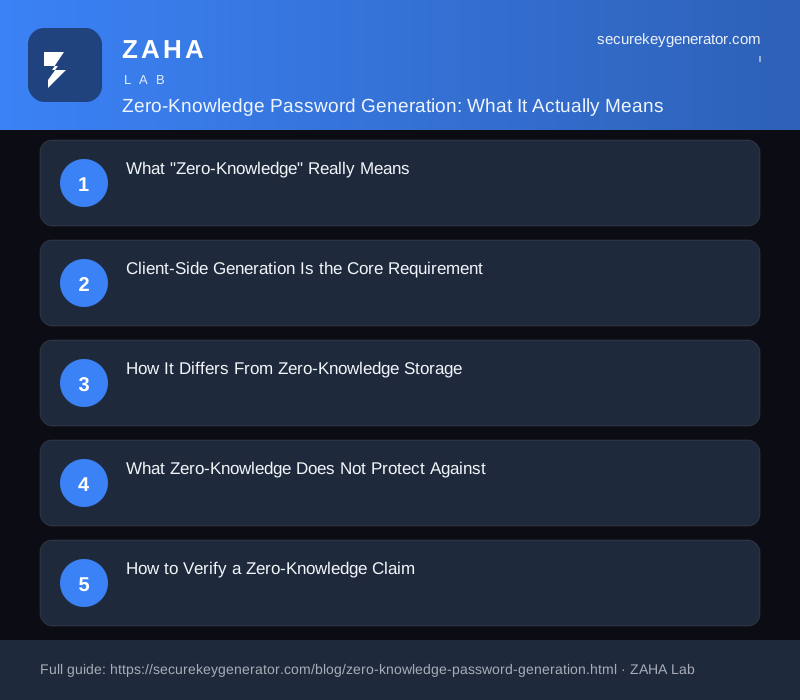
Client-Side Generation Is the Core Requirement
The single most important property of a zero-knowledge password generator is that randomness and assembly happen client-side. Modern browsers expose the crypto.getRandomValues() API, which draws from a cryptographically secure pseudorandom number generator (CSPRNG) supplied by the operating system. A trustworthy generator uses this API directly in JavaScript that runs on your device.
This matters because the alternative, generating passwords on a remote server, creates a window where your most sensitive secret exists on infrastructure you do not control. Even with good intentions, server-side generation introduces logging risk, memory-dump risk, and the possibility of interception in transit.
No network request: Generating a password should produce zero outbound traffic carrying the result. You can verify this in your browser's developer tools under the Network tab.
CSPRNG, not Math.random(): The standard Math.random() function is not cryptographically secure and should never be used for passwords or keys.
Open, inspectable code: If the generation logic is open source, anyone can confirm the secret stays local.
How It Differs From Zero-Knowledge Storage
It is easy to conflate two related ideas. Zero-knowledge generation concerns how a password is created. Zero-knowledge storage, the model used by reputable password managers, concerns how a password is saved and synced. In a zero-knowledge storage architecture, your vault is encrypted on your device with a key derived from your master password before anything is uploaded. The provider stores only ciphertext and cannot decrypt it.
A generator can be zero-knowledge without offering any storage at all. In fact, the simplest zero-knowledge generators do exactly one thing: produce a strong random string locally and hand it to you. They keep no record because they keep nothing.
What Zero-Knowledge Does Not Protect Against
Understanding the limits is as important as understanding the promise. Zero-knowledge is a guarantee about the service provider's access, not a guarantee about your entire security posture.
Compromised devices: If malware or a keylogger is running on your machine, a locally generated password can still be captured the moment it appears. Zero-knowledge cannot defend against an attacker who already controls your endpoint.
Malicious or tampered code: A zero-knowledge claim is only as good as the code actually delivered to your browser. A compromised script or supply-chain attack could exfiltrate secrets despite a clean reputation. This is why open source and subresource integrity matter.
Weak handling after generation: Pasting a password into an insecure note, emailing it to yourself, or reusing it elsewhere undoes the protection entirely.
How to Verify a Zero-Knowledge Claim
You do not have to take a provider's word for it. There are concrete checks you can perform before trusting a generator with your credentials.
Open your browser's developer tools, switch to the Network panel, and generate a password. Confirm no request carries the generated value.
Look for published, auditable source code and a clear description of which randomness API is used.
Check whether the page works offline. A genuinely client-side generator will continue to function after you disconnect from the internet, because it never needed the network to produce a result.
Review the privacy policy for explicit statements that generated values are never transmitted, logged, or stored.
Why It Matters
Passwords and API keys are among the most sensitive pieces of data you handle. The fewer parties that ever touch them, the smaller your attack surface. Zero-knowledge generation reduces that surface to its theoretical minimum: only you and your device. When combined with a zero-knowledge storage solution and disciplined personal habits, it forms a practical foundation for credential security that does not require you to extend trust you cannot verify.
We use cookies to improve your experience. Learn more
The Core Promise of Zero-Knowledge Generation
Zero-knowledge password generation means the system that creates your password never sees, stores, or transmits it. The generation happens entirely on your device, inside your browser or app, using cryptographic functions that run locally. The server learns nothing, hence "zero knowledge." Contrast this with weaker tools that generate passwords on a remote machine and send them back over the network, where they could be logged, cached, or intercepted.
How It Actually Works
A true zero-knowledge generator relies on a cryptographically secure random number generator (CSPRNG) available in the local runtime. For example, browsers expose crypto.getRandomValues(), which draws from the operating system's entropy pool rather than a predictable algorithm. The resulting bytes are mapped to your chosen character set without any round trip to a server.
When deterministic generation is used instead, your master secret is combined with a site identifier and passed through a key-derivation function like Argon2 or PBKDF2. The same inputs always produce the same password, so nothing needs to be stored at all.
What to Verify Before You Trust a Tool
Offline capability: A genuine zero-knowledge tool keeps working with your network disconnected.
Open source code: You can audit exactly where randomness comes from and confirm no data leaves the device.
No analytics on generated values: Check that tracking scripts never receive the output.
Client-side only: View the page source and confirm generation logic runs in the browser, not on the backend.
If a service emails you a password or "remembers" it for later, it is not zero-knowledge by definition.